Monuments & remembrance
Monuments, cemeteries and historic sites
Monuments, cemeteries and historic sites
Eight places in Neuville-Saint-Vaast that bear witness to sacrifice and to the community's collective memory.
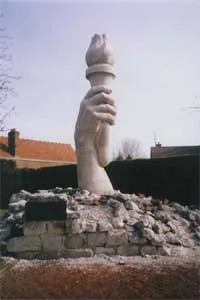
Showing the hand and forearm of a soldier rising from the ruins and holding a torch aloft, this monument stands in Neuville-Saint-Vaast at the entrance to the “Cité des Mutilés” (disabled veterans' estate), at the junction of the D937 and D49 roads.
The carved plaque on the wrist bears the inscription « Neuville Saint Vaast, 9 mai 1915 » (9 May 1915, the day the French offensive to retake the village began).
Built in 1930 and unveiled in 1932, the monument symbolises the resurrection of Neuville-Saint-Vaast after the Great War of 1914–1918. It is the work of the sculptor Charles Yrondy (1885–1960); some sources also name a M. Rafour.
To represent the ruins of the village, white stones taken from the rubble of its houses were laid at the foot of the monument.
On one of these stones is a bronze plaque engraved with these lines by Émile Poiteau (dated 2 October 1932):
« O, vivants, qui passez auprès de ce flambeau,
Qui dresse symbole aux champs des hécatombes,
Attardez vos regards sur ce sol plein de tombes,
Et songez à nos morts, dont le cœur était beau. »
(“O you, the living, who pass by this torch, raised as a symbol over the fields of slaughter, let your gaze linger on this ground so full of graves, and think of our dead, whose hearts were fine.”)
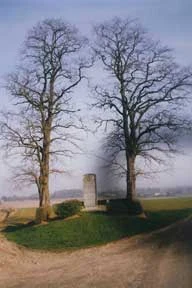
Standing at the place called “le cagin”, on the road to Arras (D49), this memorial was erected by the Leuregans family in memory of Officer Cadet Augustin Leuregans, who went missing at the age of 18 during the Great War of 1914–1918.
Pinned down in a half-buried shelter under intense German shellfire, the French territorials — soldiers no longer in their youth — hesitated to go on the attack. To spur them on, Cadet Leuregans called out:
« Allons, mes vieux papas, vous n’allez pas laisser votre enfant mourir tout seul ? » (“Come on, old dads, you're not going to let your boy die all alone?”) Dashing out of the shelter, he was killed at once and never found. But his call galvanised his old territorials, who in turn threw themselves into the battle.
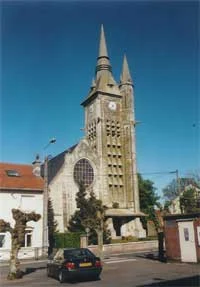
The Church of Saint-Laurent (Saint Lawrence) was completely destroyed during the First World War. The architects J. de Saint-Maurice and H. Philippe replaced the old Flamboyant Gothic church with a large Neo-Gothic building, consecrated on 14 June 1925 by Monsignor Julien in the presence of General de Castelnau.
The stained-glass windows depict the martyrdom of Saint Lawrence.
The memory of the bloodshed shaped the iconographic scheme:
• window 0: views of the Lorette cemetery and of the tower of the old church of Neuville-Saint-Vaast
• window 1: the Sacred Heart appearing to Saint Margaret Mary Alacoque
• window 2: the Virgin appearing to Saint Bernadette
• window 3: Saint Genevieve, Saint Ida
• window 4: Saint Louis, Saint Joan of Arc
• window 5: the baptism of Clovis in the presence of Saint Vaast
• window 6: the founding of Montreal, at Notre-Dame de Paris, by J.-J. Olier and J. de La Dauversière, 1640
• window 7: Saint Eligius, Saint Martin
• window 8: Saint Vincent de Paul, Saint Thérèse of the Child Jesus.
While the church was being rebuilt, Neuville-Saint-Vaast received 3 new bells, blessed on 26 November 1922 by Monsignor Julien:
• the first, “Jeanne-Firmin”, also called “oiseau de France” (bird of France), which sings the alleluia of Neuville-Saint-Vaast's resurrection, sounds F sharp.
• the second, “Germaine-Edouard”, was given in memory of the defenders, the liberators and the sons of the village who fell on the field of honour. It sounds G sharp.
• the third, “Clémence-Pierre”, replaces “Marie-Thérèse”, broken in the ruins, and sounds A sharp.
Standing in the middle of the village cemetery, it depicts a dying soldier calling out to Christ.
On the surrounding walls are engraved the names of the village's sons who died for France, together with the numbers and titles of all the French, Canadian and Allied regiments that fought to liberate the village.
A named place near the Canadian wood, once surrounding a group of poplars planted by M. Aimé Ségard.
Despite the devastation of the war, one of the roots managed to grow again and give life to “l’arbre Ségard”.
The place name survives today, but the famous tree was destroyed when the motorway was built, taking with it an old memory of another generation.
At 14 rue de la Paix, the sundial tells the time by the shadow that a gnomon casts in the sunlight. To read the exact time, however, you must allow for the difference with legal time (2 hours in summer, 1 hour in winter).
The dial is also a calendar: the blue lines drawn on the yellow-and-white chequerboard are the curves followed by the shadow of the gnomon's tip over the course of the day at a given time of year.
So the sun's entry into each sign of the zodiac gives the date: Capricorn in December, Aquarius in January, and so on.
The motto suggests that every hour of our life can be marked, and filled, by an act of kindness; it translates as:
« Toujours de service pour rendre service car le bonheur, c’est d’en donner » (“Always on duty to be of service, for happiness lies in giving it”). The sundial is the work of M. P. Acloque and Mme M.T. Lorthioir.
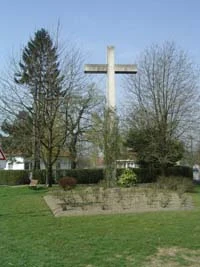
A monument on the rue de Prague, in memory of the thousands of soldiers killed during the war.
Two words carved in the stone remind us of our past:
« Souviens-toi » (Remember)
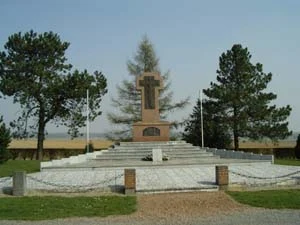
The Czechoslovak military cemetery and the monument to the Polish volunteers face each other across the main road, just before you enter the village.
They bear witness to the sacrifice of the volunteer soldiers from these countries.
Museums, cemeteries and places steeped in history around Neuville-Saint-Vaast.
Opened in 1987 opposite the Torch of Peace, La Targette military museum was the first site of David Barbiaux's “Musée vivant 14-18” (Living Museum 14-18), which displayed more than 4,500 items from both world wars.
It closed its doors at the end of 2025, along with the museum's second site at Notre-Dame-de-Lorette; the collection has been put up for sale.
To understand the fighting in Artois, the Mémorial'14-18 Notre-Dame-de-Lorette in Souchez (5 km away) is free of charge.
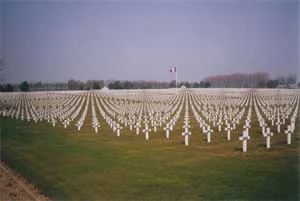
Together, La Targette's French and British cemeteries cover almost 50,000 m², with nearly 9,300 individual graves (white crosses and headstones) laid out in rows. More than 12,600 soldiers rest here (12,010 in the French national cemetery, 641 in the British cemetery).
The French cemetery is the resting place of Henri GAUDIER-BRZESKA, a sculptor and pioneer of Vorticism, killed at Neuville on 5 June 1915 at the age of 23.
To trace relatives or friends lost in the wars: Sépultures de guerre (war graves) · Mémoire des hommes (in French)
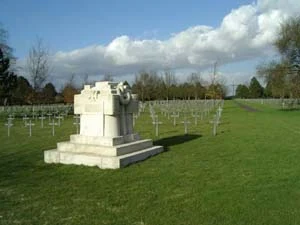
This is the largest German cemetery of the Great War in France: 44,888 soldiers rest here beneath black crosses, 8,040 of them in a mass grave.
Neuville lies at the heart of an exceptional group of remembrance sites: the Canadian National Vimy Memorial, the national cemetery of Notre-Dame-de-Lorette and the Ring of Remembrance, the history centre at Souchez, the Wellington Quarry in Arras… They are presented, together with the mining heritage and the Louvre-Lens, on the website From slag heaps to the sea (lens-tourisme.fr).
The Labyrinth was in fact the system of permanent fortifications built by the Germans during the First World War, stretching from Écurie to Neuville.
It was a mass of sandbags and concrete forming kilometres of trenches and communication trenches criss-crossing in every direction and continuing underground into deep dugouts. It was defended by guns in armoured turrets and by machine guns every 25 metres, flanked by small forts and concrete blockhouses, and protected by dense, tightly packed belts of barbed wire.
The Torch of Peace was once preceded by a monumental concrete arch marking the entrance to the Cité des Mutilés (disabled veterans' estate), built under the Loucheur Act in 1928.
When the national cemeteries were laid out, keepers were appointed to watch over and maintain the graves — jobs reserved for severely disabled veterans. These good people took up their posts with their families, but had given little thought to where they would live in villages still in ruins, where the houses being built were intended for returning inhabitants. There was no room for outsiders, so they had to fend for themselves, and so they did. Some were able to fit out and occupy huts that had been used to billet troops; others had to scavenge beams, planks and corrugated iron to build themselves a shelter. In summer it was too hot, in winter it froze, and children died. In Neuville-Saint-Vaast this situation moved a big-hearted man, Ernest PETIT, to carry out a plan he had prepared: to build at the heart of the great cemeteries. He founded a housing society, of which he was the driving force and benefactor, since the houses that gradually went up were sold to their happy owners at a fifth of their value, on generous payment terms.
The Cité des Mutilés has sixteen houses, each built to a different design, with an ornamental garden and a large vegetable plot. The interior of each was arranged according to the occupant's needs, the nature of his wounds and the number of his children.
Each house bears the name of a marshal or general who commanded in the Neuville sector during the war: BYNG (the British general commanding the Canadian Corps, which took Vimy Ridge), GOURAUD, DE MAUD'HUY, BARBOT, MANGIN, FOCH, JOFFRE, PETAIN, BALFOURIER, BERTHELOT, FAYOLLE, DE CASTELNAU, POUYDRAGUIN; one house is named LA MADELON, another OISEAU DE FRANCE, the name of a newspaper published in the occupied zone.
In the middle of the estate, the foyer des mutilés (veterans' hostel) provided lodging for families who came to pay their respects at the graves of their loved ones.
The estate runs along the rue du 11 Novembre, where 52 trees (originally maples given by Canada, now rowans) recall the 52 sons of the village who fell on the field of honour.
The hamlet of La Targette owes its name to a very old habit. To sell their produce at the market in Arras, Neuville's farmers and traders walked along what is now the D937 road.
On the way back, tired and thirsty after the long walk, sellers and buyers would stop at the first café in Neuville on their route — the one at the crossroads of the old N37 (today's D937) and the D55.
But as soon as they got home, they would invariably be greeted by the lady of the house with this remark in the local dialect:
« T’as r’fais in’n pétite attargette ? » (“Stopped off for another little dawdle, did you?”). As a friendly habit, the café in question took the sign “l’Attargette”, which popular speech turned into “La Targette” — a name the Neuville hamlet later inherited for good.
A street in Neuville-Saint-Vaast bears this name, which newcomers may find ridiculous or even insulting.
It is nothing of the sort — here is where it comes from: long before the Great War of 1914–1918, people walked to Arras to set up their stalls at the market.
Coming from Givenchy-en-Gohelle, every week they took this road, the chemin d’Arras, carrying their bundle of goods on their shoulder.
Over time, the people of Neuville took to calling them “les balloteurs” (the bundle-carriers), then, with the help of the local dialect, “les balloteux” — hence the name “chemin des Balloteux” given to the road they so often used.