 Heritage & Remembrance
Neuville-Saint-Vaast
A village in Artois · between Arras and Lens · Pas-de-Calais
“Resurgam” I shall rise again
explore↓
Heritage & Remembrance
A village in Artois · between Arras and Lens · Pas-de-Calais
“Resurgam” I shall rise again
explore↓From Gaulish settlement to Artois village: a history stretching back over a thousand years, marked by resilience.
Within the parish boundaries of Neuville-Saint-Vaast, ancient foundations, cellars and underground passages have been found at the places known as “l'allemand” and “les écouloirs”. In the old wood lay large circular pits, known as “fosses à loups” (wolf pits), probably the sites of dwellings or of Celtic oppida.
A branching tunnel, dug 8 metres below ground, served as a refuge for the villagers in times of danger. Its central gallery, almost 2 km long and vaulted with white stone, led from the abbey farm to a windmill at the end of the “Chemin Creux” (the sunken lane).
By razing the village to the ground, the Great War destroyed almost every trace of this ancient past.
Once known as “Novavilla”, then as “Neuville-l'Égalité” during the Revolution, the village grew up around the church of the monks of Saint Vaast, to whom part of it was given as early as 870 by Hincmar, Archbishop of Reims.
Its inhabitants worked the fertile land and lived in houses faced with the local white stone, in the peaceful “family individualism” typical of rural households in Artois.
Yet at the end of the 9th century (around 880) the Norsemen laid waste to the region; local tradition has them arriving by the “Saut du Ravage” — a story of destruction and rebirth that the 20th century would tragically repeat.
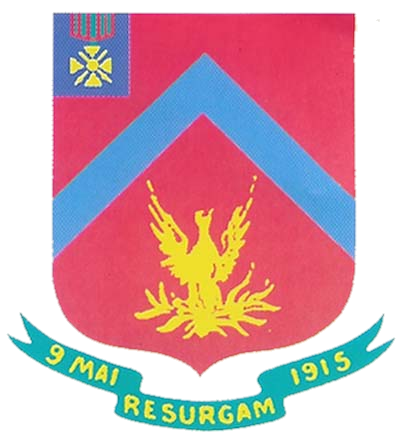
The village arms are gules, a chevron azure, with in base a phoenix rising from its flames, or. The Croix de Guerre 1914-1918, originally placed on the shield on a canton azure, now hangs beneath it.
The arms were designed by Ernest Petit in 1921. At the base runs the inscription 9 mai 1915, Resurgam! (9 May 1915, I shall rise again!). 9 May 1915 was the first day of the Artois offensive, which would free the village at the cost of its complete destruction.
The memorials and war cemeteries keep alive the painful memory of the soldiers who died on the village's soil.
“9 May 1915 — Resurgam!”
« Les fiers culs de Neuville » — a cheeky local nickname, roughly “the proud folk of Neuville” — is what the people of Neuville-Saint-Vaast are called throughout the area. The nickname reflects a certain pride, rooted in an old custom.
In times past, a man who wished to marry a girl from Neuville had to own a white horse. Only on that condition would her parents consent to the marriage.
Look closely and you will see that many houses bear a date between 1920 and 1930. Some of the stone façades are now recognised for their architectural value.
The church tower, some forty metres high, can be seen from far away and is easily recognised by its small spirelet. In the afternoon sun, the flames of the stained-glass window recalling the martyrdom of Saint Lawrence — the church's patron saint — begin to glow.
The Rue du Canada leads to the Canadian National Vimy Memorial, to the north of the village: hallowed ground where each tree is said to stand for a soldier who died for the freedom of the French people.